

The Quick Version
- Australian startups raised $5.4 billion in venture capital in 2025, but the deal count dropped 20%, and capital was concentrated in the top 20 deals, leaving most founders competing for a shrinking share
- Alternative finance covers funding outside traditional bank loans and equity investment, including invoice finance, revenue-based finance, R&D finance, and crowd-sourced equity funding
- The Reserve Bank of Australia confirmed significant growth in non-bank business lending since 2022
- R&D finance lets companies borrow against eligible R&D expenditure they’ve already incurred, bridging the gap between spending on R&D and receiving the R&DTI rebate
- For startups with active R&D programmes and cash flow pressure, alternative finance is increasingly a deliberate strategic choice
Australian startup funding looks healthy from a distance. In 2025, venture capital investment hit $5.4 billion across 390 deals, according to the State of Australian Startup Funding report by Cut Through Venture and Folklore Ventures. That’s a 31% increase on 2024 and the third-largest funding year on record.
But the headline obscures a harder reality. Deal count fell 20% from the previous year. The top 20 deals captured 58% of all capital raised. And AI-first companies attracted a disproportionate share, leaving non-AI founders in a structurally tighter market.
For the majority of Australian startups, the question isn’t whether capital exists. It’s whether the capital available to them comes on terms they can afford, at a speed that matches their growth cycle. That’s where alternative finance in Australia enters the conversation.
What Is Alternative Finance?

Alternative finance is any funding source outside traditional bank loans and equity investment. It includes invoice finance, revenue-based finance, venture debt, crowd-sourced equity funding, private credit, and specialist products like R&D finance.
The category has grown quickly in Australia. The Reserve Bank of Australia’s February 2026 Bulletin found that non-bank business lending has expanded significantly since 2022. More specialist lenders are entering the market, brokers are increasingly referring businesses away from the big four, and reduced regulatory capital requirements for SME loans (effective from January 2023) have made it cheaper for banks to compete, which has pushed everyone to sharpen their offerings.
The shift reflects something broader than product availability. Founders’ attitudes toward capital have changed. Standard Ledger’s April 2026 market analysis noted that smart founders are increasingly using debt between equity rounds to extend runway and reach better metrics before their next raise. R&D tax incentives, in particular, were described as a “significant source of non-dilutive capital that’s often underutilised.” Alternative finance in Australia is no longer a last resort. For many founders, it’s a first move.
Why Australian Startups Are Turning to Alternative Finance
The practical reasons map to four recurring pressure points.
Equity dilution tops the list. Seed-stage median round sizes in Australia hit A$2.5 million in 2025, up 150% from A$1.0 million in 2022, according to NUVC’s analysis of Australian startup fundraising benchmarks. Larger rounds mean more dilution per raise. And with only 22% of seed-funded Australian startups progressing to Series A, giving up equity early carries significant risk. Many founders are actively seeking non-dilutive alternatives that let them retain control while they build.
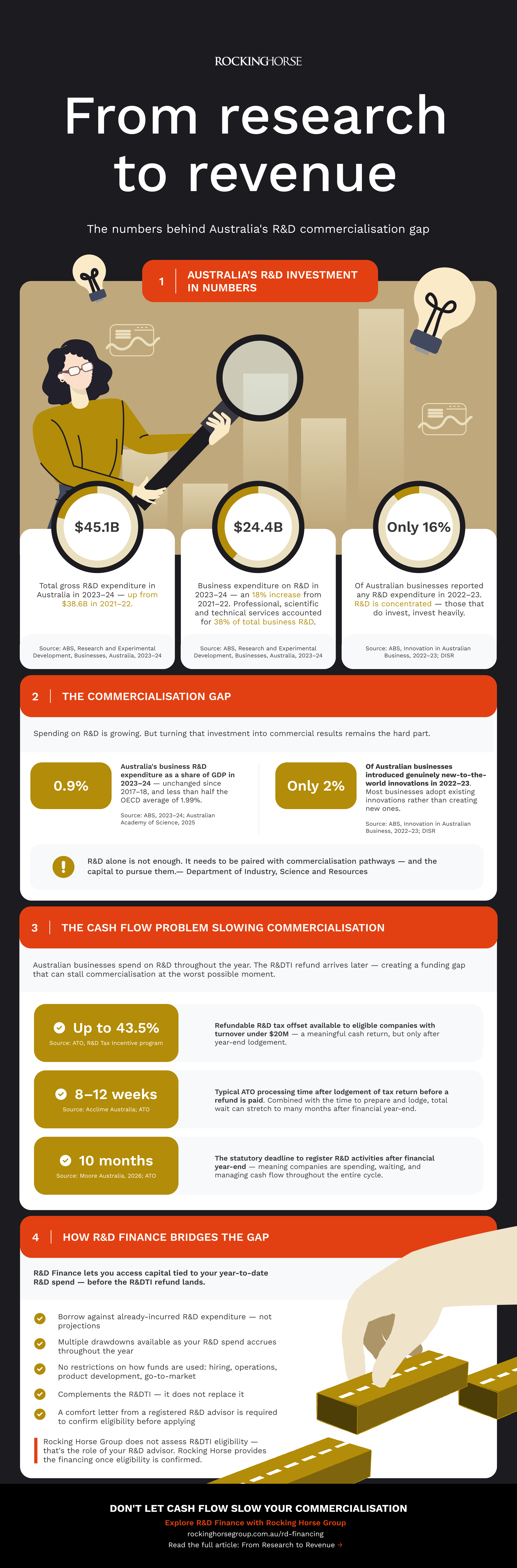
Cash flow timing is another pressure point. Companies conducting eligible R&D in Australia can claim the R&D Tax Incentive (R&DTI), which provides a refundable tax offset on qualifying expenditure. But the rebate arrives as a lump sum after tax lodgement, often 12 months or more after the money was actually spent. For a startup burning capital on product development, that’s a long time to wait for cash the government already owes you.
Rising costs compound the problem. Australia’s annual inflation climbed to 3.8% in December 2025, wages rose 3.4% over the year to September 2025, and the RBA raised the cash rate to 3.85% in February 2026. For early-stage businesses, these increases land on top of an already-tight funding environment.
Then there’s speed. A traditional bank loan application takes 21 to 35 days from submission to funding. Alternative lenders and fintech providers often move within days. When a hiring decision, a product milestone, or a supplier commitment depends on capital being available now, that speed gap matters.
Types of Alternative Finance Available in Australia
There’s no single product that fits every situation. Alternative loans and funding products come in several forms, from revolving lines of credit tied to your receivables through to one-off facilities secured against a specific asset. Here’s a brief overview of the main options.
Invoice finance lets businesses access cash tied up in unpaid invoices before payment terms expire, and scales with the debtor book. Revenue-based finance provides capital in exchange for a percentage of future monthly revenue, with repayments adjusting based on income. Venture debt provides capital to VC-backed companies between equity rounds, extending runway without additional dilution. Crowd-sourced equity funding (CSF) allows companies to raise up to $5 million in a 12-month period from retail investors through an ASIC-licensed intermediary, though regulatory requirements are more involved.
Then there’s R&D finance, which works differently from everything listed above. Instead of lending against revenue, assets, or invoices, an R&D finance provider lends against eligible R&D expenditure your company has already incurred during the current financial year. It’s designed specifically for businesses claiming the R&DTI, and it’s covered in more detail below.
R&D Finance (A Specialist Option for Companies Doing Real Research)

R&D finance sits in a different category from the other products listed above, so it’s worth understanding how it actually works.
Australian businesses spent $24.41 billion on R&D in 2023–24, according to the ABS, up 18% from two years earlier. Of the 12,956 companies that lodged R&DTI claims, nearly half were small business owners and operators. That’s close to 13,000 companies dealing with the same structural problem: spending on R&D now, waiting months for the government to pay them back.
R&D finance addresses that gap directly. Through a specialist R&D finance provider, a company can access funds within two weeks of approval. The loan settles automatically when the ATO pays the R&DTI rebate, with no monthly repayments in the interim. The structure is entirely non-dilutive (no equity, no personal guarantees), and there are no restrictions on how the funds are used.
Multiple drawdowns are available throughout the financial year as eligible expenditure accrues, so funding grows alongside the business’s R&D programme.
Two things matter in how this is understood. First, R&D finance complements the R&DTI. It doesn’t replace it. A company must be eligible for the incentive to access the finance. The two are interconnected. Second, the lender doesn’t assess R&DTI eligibility or prepare claims. That responsibility sits with the company’s R&D tax consultant, who provides the comfort letter that underpins the loan.
Is Alternative Finance Right for Your Startup?
There are a few signals worth paying attention to.
If your startup is growing faster than its cash flow can support, some form of alternative finance in Australia is probably worth exploring. That might mean invoice finance if you have a strong debtor book, revenue-based finance if you have predictable monthly income, or venture debt if you’re between equity rounds and need to extend runway.
For companies conducting eligible R&D specifically, the calculus is more targeted. If you’ve already incurred R&D expenditure and are waiting months for the R&DTI rebate to arrive, R&D finance can bridge that gap directly. The same applies if you’re scaling but reluctant to dilute at a valuation that doesn’t reflect your traction.
When evaluating any option in the alternative lending market, pay attention to interest rates, exit fees, and whether the provider genuinely understands your industry. A generalist lender might offer you a product, but they won’t know the R&DTI programme, the government’s processing timelines, or what a comfort letter is. That knowledge gap can slow down the application process and create unnecessary friction when you need to move quickly.
The cost of capital always matters, but so does the cost of the alternative. A venture capital round that solves your cash flow problem also permanently reduces your ownership. Alternative loans cost interest over a defined period and leave your equity intact.
How We Help at Rocking Horse Group
Here at Rocking Horse Group, R&D finance is all we do. We’re a specialist financial service provider, not a bank, not a venture fund, and not an R&D consultant. Our sole focus is lending against eligible R&D expenditure that Australian businesses have already incurred.
That specialisation makes a difference. Our team understands how the R&DTI programme works, how long ATO processing takes, and what your R&D tax consultant needs to provide in the comfort letter. Because we do this every day, the process moves faster, and there are fewer surprises along the way.
A few things that set us apart:
- Funding from $50,000 to $10 million, calculated at up to 80% of your expected R&DTI rebate based on year-to-date spend
- No equity dilution, no personal guarantees, and no restrictions on how you use the funds
- Funds are typically delivered within two weeks of approval
- Multiple drawdowns available throughout the financial year as your eligible spend grows
- If you don’t yet have an R&D tax advisor, we can connect you with one in our network
If you’re conducting eligible R&D and want to understand how much you could access, talk to our team or try the R&D expenditure calculator to get an estimate based on your year-to-date spend.
Frequently Asked Questions
What counts as alternative finance in Australia?
Alternative finance in Australia refers to any funding source outside traditional bank loans and equity investment, including invoice finance, revenue-based finance, venture debt, crowd-sourced equity funding, private credit, and R&D finance. The Reserve Bank of Australia confirmed a notable increase in non-bank business lending in its February 2026 Bulletin.
How does R&D finance differ from other types of alternative finance?
Most alternative finance products lend against revenue, assets, or invoices. R&D finance lends against eligible R&D expenditure already incurred during the current financial year, secured against the expected R&DTI rebate. The loan settles when the ATO pays the rebate, with no monthly repayments in the interim.
Do I need to complete my R&DTI claim before accessing R&D finance?
No. R&D finance is available during the financial year, based on the expenditure you’ve already incurred. You’ll need a comfort letter from your R&D tax consultant confirming your eligible spend, but you don’t need to wait until the formal claim is lodged with the ATO.
Can I use R&D finance alongside other funding sources?
Yes. R&D finance works alongside venture capital, government grants, accelerator funding, and other forms of alternative finance in Australia. It’s a loan secured against expenditure you’ve already incurred, so it doesn’t conflict with other capital sources. Your company must be eligible for the R&DTI and have a comfort letter from your R&D advisor.
Are the R&DTI rules changing?
The 2026–27 Federal Budget proposed several changes to the R&DTI, effective from 1 July 2028 if legislated. The most relevant for startups: the refundable offset turnover threshold would increase from $20 million to $50 million, and refundability would be limited to companies under 10 years old. Core R&D offset rates would also increase by 4.5 percentage points. These are proposed changes, not yet law. Current rules apply through to at least 30 June 2028.